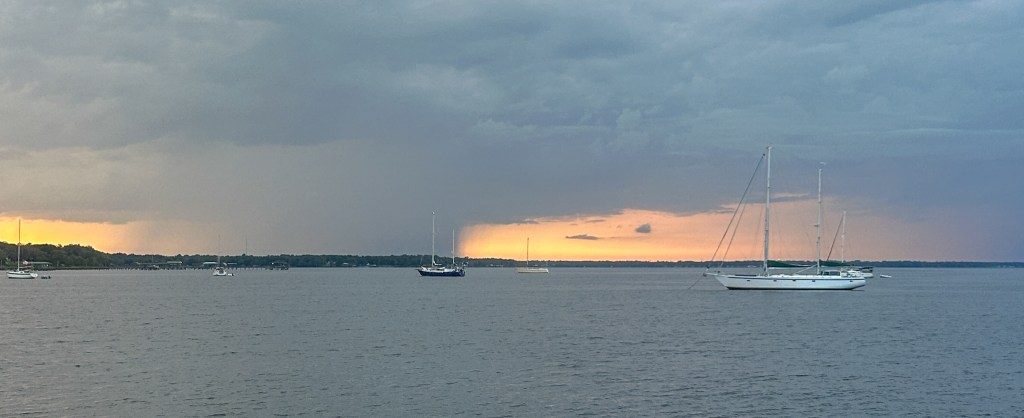
One night, on our second time at anchor, we discovered the significance of being able to anchor properly and have good ground tackle. Dark had just settled in, and I noticed the wind picking up. The stars were no longer as visible as the clouds rolled in and the boat began to shudder as the thunder clapped all around us.
Winds picked up to 35 mph sustained and 55 mph gusts. I looked around outside and could see some anchor lights and lights on shore; I didn’t think we were moving, and our anchor alarms confirmed that we were staying at the end of the chain and just swinging with the wind and the current.
Before we took sailing lessons, I think I believed that when you wanted to drop anchor, you just dropped the anchor, and you were good to go. After sailing lessons, I came to learn that it’s not really the weight of the anchor that holds your vessel in place, but rather how it digs into the bottom.
What you need to do is drop your anchor and then start letting out some additional chain depending on depth and conditions. (The minimum is typically 4 feet of chain for every foot of depth, that goes up depending on conditions and local customs.) As you are dropping the additional chain (when you know you’ve hit bottom), you start backing the boat as more chain is let out. This prevents the chain from getting tangled on itself.
Once all the chain is out that you want out, you keep the boat in reverse, and back down to get the anchor to set in the bottom. Once you are confident you aren’t moving, I then attach the bridle and let out an extra fifteen to twenty feet. So that the pressure of the anchor is on the hulls and not the windlass.
The bridle is a section of line(rope) that has each end connected to each hull. The middle then is clipped onto the anchor chain to get the pressure onto that line. This does also help keep the anchor secure at the bottom.
We have developed a pretty good system. It started when we were in the San Juan Islands a few years ago and then we’ve worked to refine it now that we’ve been off the dock. Sandy is at the helm, I’m at the bow. I drop the anchor and she holds our position as much as possible. Once we have the anchor at the bottom (which I determine by using the depth finder and then counting the marks on our chain), I start giving the commands for where the boat needs to go. She repeats it so I know she’s heard me and then commences with what I asked her to do.

Right now, we are lucky because we are anchoring in mud. Our anchor holds well in the mud. Most of the places we plan to go right now will likely be sandy, so our anchor should hold well.
One of the ‘improvements’ that we made was to buy a new bridle from a company that makes bridles specific to boats. They have made thousands of these for Lagoon 410s. Our bridle was specific to ‘our’ boat. I put that in quotes because these are production boats, and it could be used on any Lagoon 410.
Let me also say that while we have things down in terms of anchoring, we aren’t experts. My brief description is leaving out a lot of nuances and probably a few details that are important that others who have more experience would say, “What about this?”. They probably are right.
Anchoring is a crucial skill when you are cruising, without being able to get our anchor as good as we did that night, we would have been dragging. You want to know that as you sleep that you are going to stay in one place and not either be washed ashore or run into another boat.

 The Great Wander
Leave a comment